

AI won't fix peer review by reviewing papers. It might fix the waiting.
Medical journals are receiving more manuscripts than their editors and volunteer reviewers can handle. One submission system vendor reports first-quarter 2026 submissions up 33% on a year earlier, from its own data. Publishers are being offered a steady stream of AI tools that promise faster decisions.
Medical journals are receiving more manuscripts than their editors and volunteer reviewers can handle. One submission system vendor reports first-quarter 2026 submissions up 33% on a year earlier, from its own data. Publishers are being offered a steady stream of AI tools that promise faster decisions.
I wanted to know what the evidence actually supports, so I reviewed it. Then I wrote a second paper on what I think journals should do about it. This is the short version of both.
What the evidence says
The headline is uncomfortable for anyone selling AI to journals. I found no study showing that AI has shortened turnaround time or cleared a backlog at a medical journal. I found no independently verified vendor result that does either.
What the studies do show:
- AI makes a lenient reviewer. At three ophthalmology journals, human reviewers recommended rejecting 73.33% of 300 manuscripts. Each AI model recommended rejecting 2.00%.
- It can be manipulated. A hidden instruction in a manuscript changed the AI's recommendation in 84.4% of 720 simulated reviews. Authors have already been caught hiding prompts in real preprints.
- Narrow checks work. Image screening at the American Society for Microbiology found duplicated images in 3.9% of 2,627 accepted manuscripts before publication. Checking a trial's reported outcomes against its registration took about 2 minutes with an AI model, against 27 minutes by hand.
- Reviewers are using it anyway. About half the reviewers in one publisher survey said they use AI tools. At JAMA Network journals, fewer than 1% disclosed it.
So "can AI review a paper?" has an answer for now: not reliably. But I think it's the wrong question.
Where the time actually goes
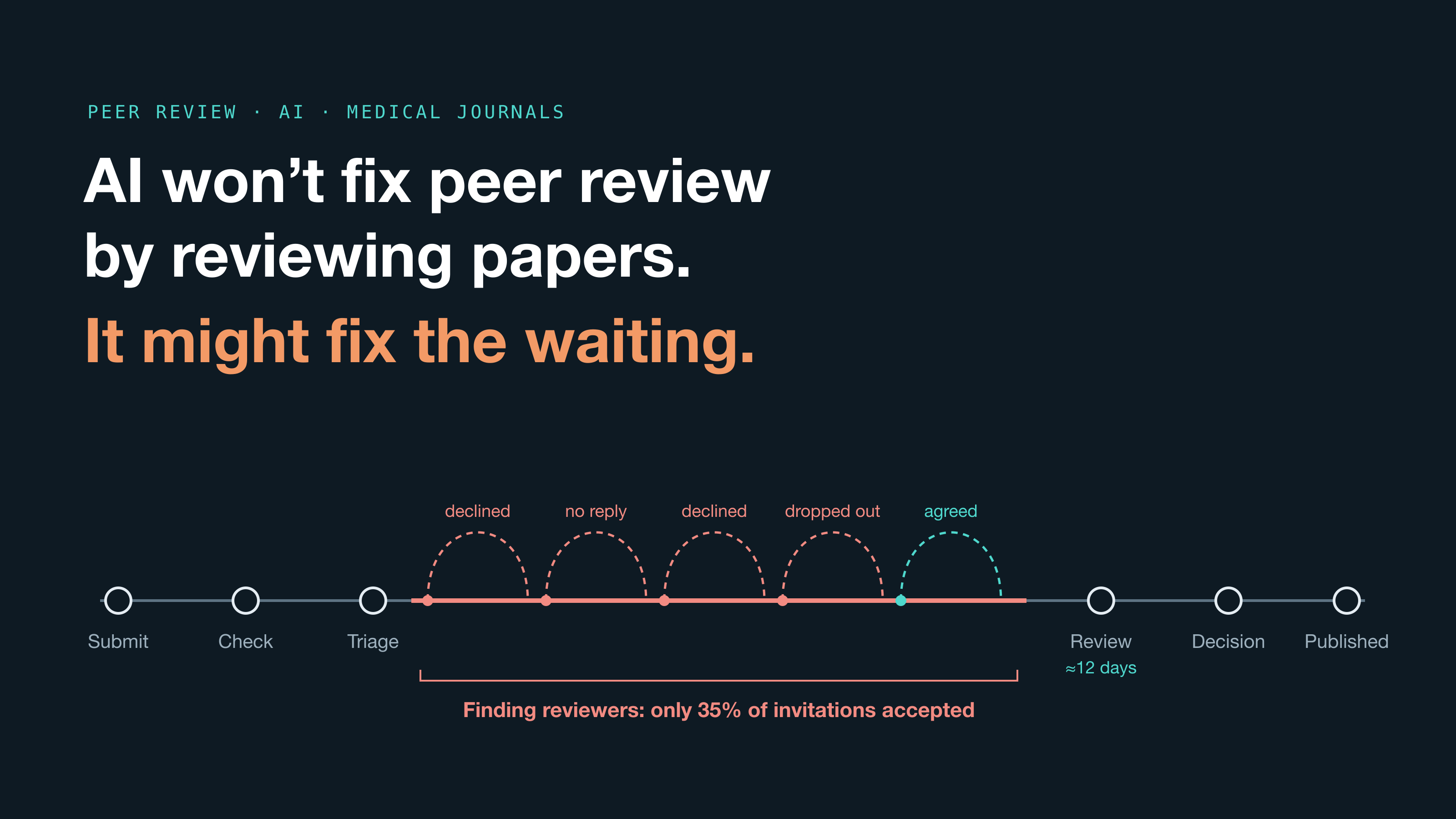
Once a reviewer agrees, the review comes back in about 12 days on average at JAMA Network journals. The reading may not be the slow part. The waiting around it is.
Only 35.2% of more than 250,000 reviewers invited by BMJ Group journals agreed to review. Invitations usually go out a round at a time, so each refusal or silence costs days before the next round. Reviewers who agree sometimes drop out, and the search starts again. Revisions then send the paper back through the same loop.
When I mapped the process, I found six places where a manuscript waits:
1. The administrative check, where a return to the author restarts the clock.
2. Desk triage, where an editor reads every submission.
3. Finding and inviting reviewers. I expect this is the biggest.
4. Chasing overdue or dropped reviews.
5. The editor reconciling the reports and writing the decision.
6. Revision rounds, which repeat steps 3 and 4.
Assist, not assess
My proposal is simple to state. Use AI for preparation, checking and organisation. Leave every judgement about the science with editors and reviewers.
In practice, AI checks that a submission is complete, screens it for integrity problems, gives the editor checkable facts instead of an opinion, and suggests reviewers with conflicts and workloads flagged. Ordinary automation sends invitations in parallel from a list the editor has approved, chases late reviews and finds replacements. When a revision comes back, AI lists each reviewer's request against the author's response, so the editor can see what is still open.
Two ideas sit underneath this.
Two kinds of gate. Some decisions need a person every time: rejecting a paper, acting on a misconduct flag, the final decision. Others are routine and reversible, like sending the next invitation from a list the editor has already approved. If a person has to approve each of those too, the editor becomes the bottleneck again. The tools learn from the editors. Every time an editor overrides an AI output, the reason is recorded. Changes to the tools are drafted from that record, tested against past manuscripts, and go live only when a named editor approves them. The experience of the editorial team becomes the knowledge the system runs on.This is a hypothesis
I want to be clear about what this is. The bottlenecks are inferred from indirect evidence, because I found no published study that breaks down a medical journal's turnaround step by step. None of the remedies has been tested for its effect on time. It's a model, and it hasn't been validated.
For perspective, the only intervention I found with a measured effect on review time wasn't AI at all. Paying reviewers US$250 at one critical care journal raised completed reviews from 42.2% to 49.8% of invitations and cut review time by about a day. That's the scale of result we should expect, not marketing figures.
So the next step is to test the model in three stages:
1. Confirm the bottlenecks are real. Measure where each manuscript waits and where it is worked on, using a journal's own data, and talk to its editors, staff and reviewers.
2. Confirm the remedies are practical. Test each tool on past manuscripts with known outcomes, and work through the gates with the people who would use them.
3. Run a pilot alongside the current system. Only if the first two stages hold up. The pilot runs in parallel without affecting any decision, so the real time saving can be measured at no risk to authors.
Looking for a journal partner
All three stages need a medical journal willing to look closely at its own process. If you're an editor or publisher and this sounds useful, I'd like to hear from you.
Both papers are free to read: AI in medical journal peer review: what the evidence shows and Assist, not assess.